Vibe Coders vs. Manual Coders: The Coming Split in Software Development
I Watched Primeagen Struggle with Cursor So You Don’t Have ToThere’s a tectonic shift happening in software development.
Vibe Coders vs. Manual Coders: The Coming Split in Software Development
I Watched Primeagen Struggle with Cursor So You Don’t Have To
There’s a tectonic shift happening in software development. On one side, you have traditional developers — deep in the trenches of their editors, hand-coding every line, managing every dependency, and resisting the pull of LLMs. On the other side, a new breed is emerging: vibe coders — developers who build applications in collaboration with AI, not as a novelty, but as their default workflow.
I call this the delineation. And the line has already been drawn.
I Watched Primeagen Struggle So You Don’t Have To
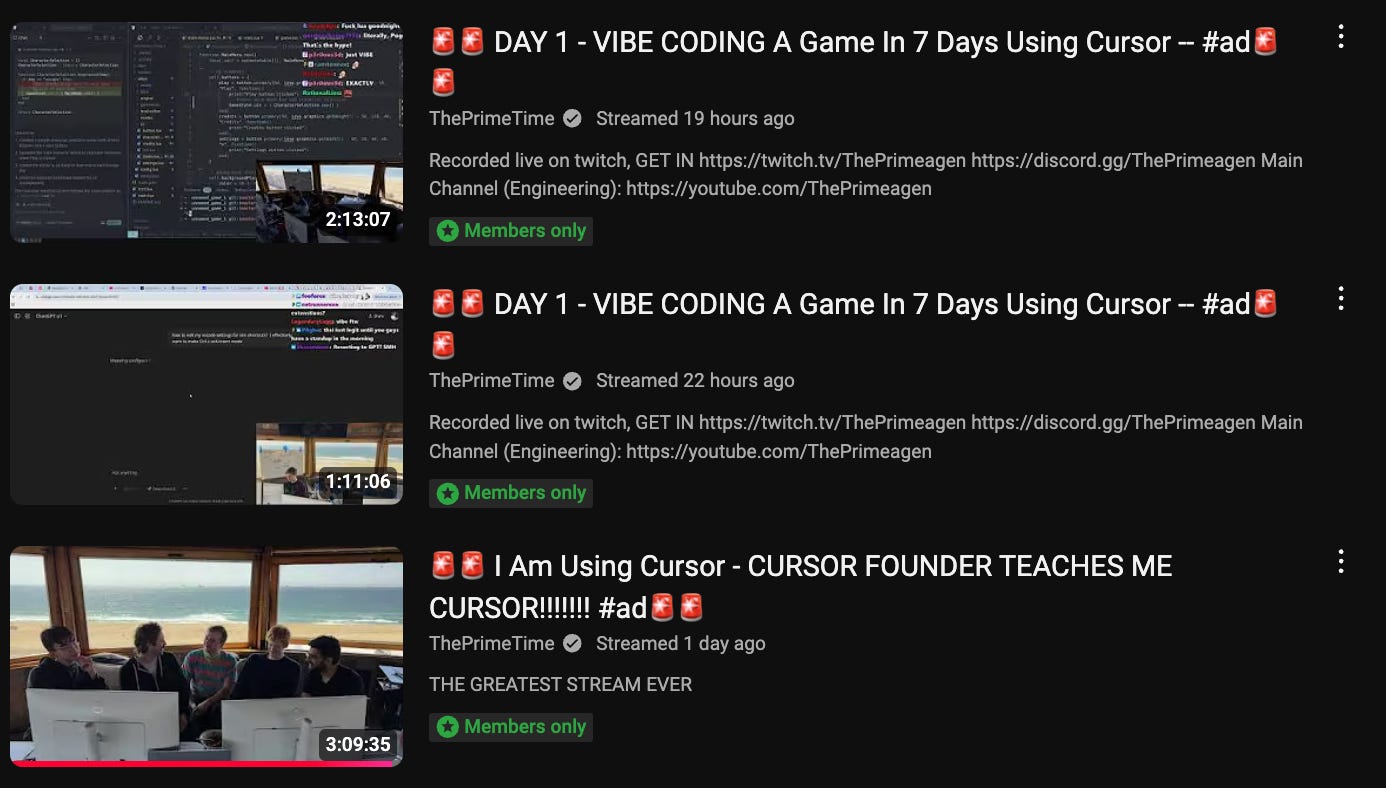
To understand this divide in real time, I’ve been watching the start of a seven-day live coding stream with ThePrimeagen, TJ, and their team using Cursor — a VS Code fork that deeply integrates AI — to build a complex game entirely with LLM support.
From the jump, one thing became crystal clear: Prompting is not about syntax. It’s about mental models.
The project’s skeleton was vibe-coded in about five minutes by one of their teammates. No typing. Just fast, clean AI-assisted scaffolding. Primeagen, on the other hand, spent the better part of an hour hand-coding and struggling with state rendering. Eventually, he handed it to TJ, who fixed it in seconds.
The problem wasn’t ability — Primeagen is an elite coder. It was prompt fluency. He had the full idea in his head but couldn’t structure it into a clear request. He could rant the solution for 45 seconds straight, but that rant never became a proper prompt. That’s the skill gap.
This is the new challenge for devs: Can you communicate with the machine in terms it can execute?
Prompting Is Architecture Made Explicit
Here’s the core insight: prompting isn’t about autocomplete. It’s not a replacement for typing. It’s a tool for sculpting systems from ideas.
The developers who thrive with LLMs aren’t just faster — they’re better at externalizing their mental models. Vibe coders don’t blindly trust the AI. They know what they’re building. They simply let the AI fill in the space between the dots.
Even more, with Cursor’s features like CursorTab and custom Lua rules, they can shape the agent’s behavior to follow their architectural vision. In the stream, their Lua rules file was barely eight lines long — but those few constraints made the AI dramatically more aligned with the project’s goals.
LLMs don’t replace your brain. They amplify your clarity.
Tooling Is Infinite — What Matters Is Awareness
There’s no shortage of ways to integrate AI into your workflow. Whether you’re a VS Code loyalist, a NeoVim hacker, or a command-line minimalist, the options are endless:
• Cursor – AI-native IDE with multi-model support
• Zed Editor – built for speed and multiplayer AI coding
• Neovim x Aider – CLI-first agent interaction
• Claude Code (by Anthropic) – new AI-native coding experience
• Custom tooling – your own prompt runners, scripted interfaces, or local agents
The point isn’t to pick one tool. The point is to ask:
How much cognitive load are you willing to offload?
The best developers I know aren’t just good at typing. They’re good at thinking in layers. That’s what makes vibe coding work. They don’t just prompt. They guide. They script. They scaffold. They manage context across files and workflows. They treat the LLM like a junior developer — capable, but in need of direction.
My Journey: From C++ to GPU Clusters to Prompt Architecture
I didn’t start as a vibe coder. I came up through the classic path.
As a teenager, I was modding games in C++. In college, I learned C, Java, Bash, sed, and awk. I later picked up Python, using it alongside Bash for Linux sysadmin work and networking scripts.
When DevOps started spreading to startups, I was at the 49ers composing scripts with Ansible and Chef — long before AWS was what it is today.
At Verizon Labs, I leveled up. We were a Java and Go shop, building codecs, streaming engines, and virtual machines for XR over the cloud. I led work on GPU orchestration, cluster management, and internal developer tooling.
The constant throughout all of this?
I was always an architect.
I needed a high-level understanding of how everything connected. That’s what made me successful — and that’s exactly what makes prompting work for me now.
When you’ve internalized the system, prompting is just externalizing your mental state to an agent.
Offload What You Can. Control What You Must.
You don’t need to prompt everything. That’s the beauty.
You can use AI for:
• UI generation
• Unit tests
• API stubs
• Migration scripts
• Code movement / refactors
And keep manual control over:
• Business logic
• Data modeling
• Security decisions
• Architecture choices
You can configure agents, add markdown notes, tag important files, define custom rules, even pipe in current documentation or web results from tools like Perplexity. This isn’t “chat and copy-paste” — it’s a multi-layered development workflow.
For blockchain devs, AI can write gas-optimized contracts, explain validator logic, and refactor for security. As long as you know what you’re doing, you can direct the AI accordingly.
You don’t have to do it all. You just have to know what to ask.
The Tools Are Evolving. Are You?
We’ve been using GitHub Copilot in VS Code since before ChatGPT dropped.
GPT-3.5 changed everything. Now we’ve got:
• Claude 3.7
• GPT-4o
• GPT o3-mini
• DeepSeek R1
• Reasoning Traces from all thinking Models
• And many more
LLM-native IDEs are exploding.
LLMs are getting faster.
Context windows are expanding.
LLM agents will only get smarter.
We’re just at the beginning of the LLM-powered dev stack.
Conclusion: Coders Who Flow vs. Coders Who Fight
You don’t have to abandon your current workflow. But you do have to stay aware.
The future belongs to developers who can:
• Think architecturally
• Communicate clearly
• Iterate with agents
• Define boundaries
• Maintain flow
AI doesn’t replace developers. It replaces developers who can’t adapt.
If you’re open-minded and intentional, AI becomes your jetpack.
If you’re stubborn and rigid, it becomes your wall.
Vibe coders flow. Manual coders fight.
The choice is yours.