 Quincy Labs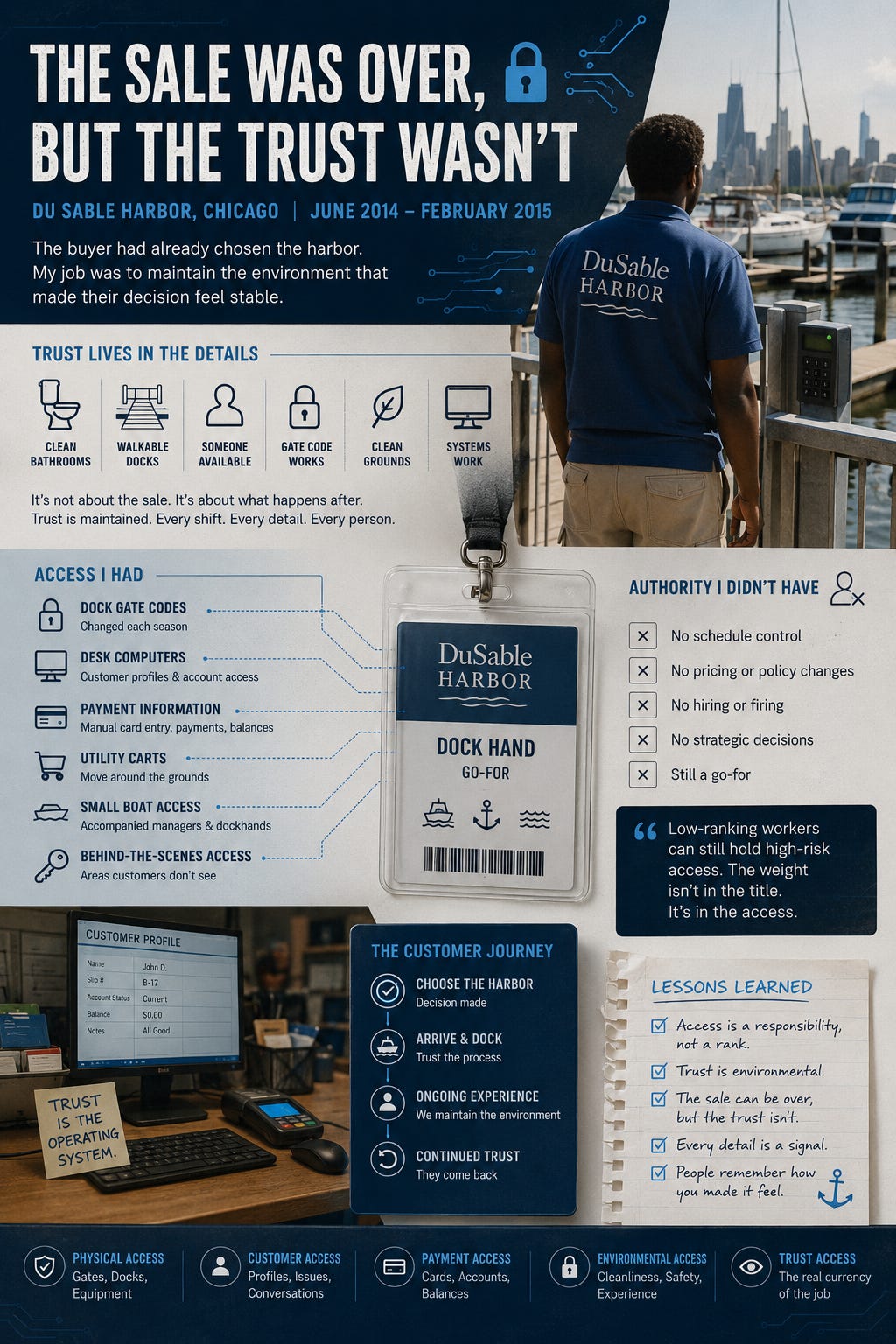
More specifically, I found a dock worker role with Suntex at DuSable Harbor. This was around June 2014 to February 2015, and I found the job on Craigslist.
That alone felt like something.
Levi’s had me sitting around too often, waiting to see if I’d get scheduled, called in, or given a short closing shift that barely made the commute feel worth it. Finding the harbor job made me two-job shawty for a minute, which felt better than sitting at home hoping Levi’s would call me in.
It was outside my comfort zone, but not in the same way retail had been.
At Levi’s, the discomfort came from having to perform styling and sales energy on demand. At the harbor, the work was more physical, more environmental, and more service-based. Put the shirt on, be identifiable, be available, and handle what needed to be handled.
A morning could start with turning on the two checkout desk computers. Ideally, the manager had already lifted the store guard. Then there were the public restrooms, male and female, which had to be cleaned and replenished. The front desk had shelves in front of it with snacks, drinks, Dramamine, and basic items people could buy. Behind that was the manager’s office and a utility closet.
During boating season, the work moved around.
We’d help boaters with mooring and departures. We’d walk the docks to see if anybody needed anything. We’d keep the grounds clean, the parking lot clean, and the dock waters clear of excess trash or dead fish. We’d help refill the drink cooler or stock the shelves if nobody else had jumped on it. Sometimes there were meter readings or audits on dock boxes.
A customer could be someone who actually docked with us. It could be someone settling an unpaid balance, slip fee, fuel charge, or general account issue. It could be somebody who just stopped in and wanted a drink or a snack. At peak season, there was a mix of boat owners, guests, tourists, and random walk-ins. As the season slowed down, it was more boaters, randoms settling things, and eventually just randoms.
So the buyer’s journey was different again.
At O’Brien’s, the buyer had already decided.
At Macy’s, I was processing sales and sometimes supporting consideration.
At Levi’s, the buyer was still trying things on.
At DuSable Harbor, the sale was mostly over.
A lot of the real work sat after the purchase decision. Someone had already chosen the harbor, already had a slip, already trusted the place with their boat, or already walked in expecting the basics to work. My job wasn’t to convince them to buy into the harbor. My job was to help maintain the environment that made their decision feel stable.
That’s where trust lived.
In the bathroom being clean.
In the docks being walkable.
In somebody being around if a boater needed help.
In the gate code working.
In the grounds not looking neglected.
In the front desk being able to pull up a customer profile or take a payment without making the interaction harder than it needed to be.
The access was heavier than the title made it sound.
I was still a go-for, but this time I had access to more consequential things. I had dock gate codes that changed each season. I had access to the desk computers. I could pull up customer profiles. If someone needed to settle something or update their information, I could help bring up their account. I could manually enter bare credit cards into the same general area where we’d ring up a candy bar.
That’s wild to think about now.
A low-ranking worker could be cleaning a restroom, refilling a cooler, walking a dock, and then handling someone’s payment information in the same shift.
That’s an access lesson.
DuSable Harbor taught me that low-ranking workers can still hold high-risk access.
Not glamorous access. Not executive access. Not the kind of access people write strategy decks about. But real access.
Physical access.
Customer access.
Payment access.
Gate access.
Environmental access.
The kind of access that matters because something can go wrong if the person holding it doesn’t understand the weight of it.
I had access to the docks through the gate codes. I had access to utility carts to move around the grounds. I never operated the small speed boat myself, but I did accompany managers and other dockhands when a circumstance required it. I had access to the fitting-room equivalent of the marina, meaning the behind-the-scenes areas customers didn’t fully see but depended on anyway.
But I didn’t have much authority.
I couldn’t make my own schedule. I had a uniform. I had expectations around how I was supposed to look, where I was supposed to be, and what I was supposed to do. I was basically a go-for again, just in a different environment.
The uniform was its own constraint too.
The city-provided blue shirt didn’t have much life to it, and the khaki expectation felt like it came from somebody else’s idea of neutral. I had my own shorts I preferred, and I wasn’t exactly building my wardrobe around harbor khaki compliance. That was always a thing.
The environment had another layer I didn’t have language for at the time.
A lot of the work placed me in service to people whose leisure looked very different from my life. This was the dock next to Navy Pier. The boats, the slips, the casual way people moved through that space, it was a whole world I hadn’t really been around before.
I didn’t know anything nautical before that job, so even the basic parts of the work gave me exposure I wouldn’t have gotten otherwise.
That part was useful.
The job helped get me out of my shell a bit more too, but not through retail performance. More through proximity. You’re in the shirt. You’re on the dock. Somebody needs something. You figure out how to respond.
There were characters among the other dockhands. Some still exist somewhere in the Facebook layer of life, but that’s really it. There was also workplace messiness around management and staff that reminded me I was seeing only one layer of the operation. I didn’t know what was true, what was rumor, or what had been handled above me. I just knew the environment had its own politics, and I was still low on the ladder.
When the season ended, they tried to have some of us convert into helping set up the Millennium Park ice skating rink.
I did it for a few days.
But by then, the job felt like it had become something else. The hours, the pay, the cold, the new supervisors, the unfamiliar grizzly energy around January and February, none of it felt like the move. Whatever made sense during boating season felt dead by winter.
So I started looking for another way.
Eventually, that led me to Trunk Club.
Looking back, DuSable Harbor wasn’t a buyer’s journey lesson in the traditional sales sense. It was more of a customer journey lesson. The customer had already bought in, docked, arrived, or trusted the place enough to hand over payment information.
The question was what happened after that.
Was the harbor clean?
Was the dock accessible?
Was the person at the desk competent?
Was the payment handled correctly?
Was the environment being watched?
Was the basic trust of the place being maintained?
That’s what the job showed me.
The sale can be over, but the trust isn’t.