 Quincy Labs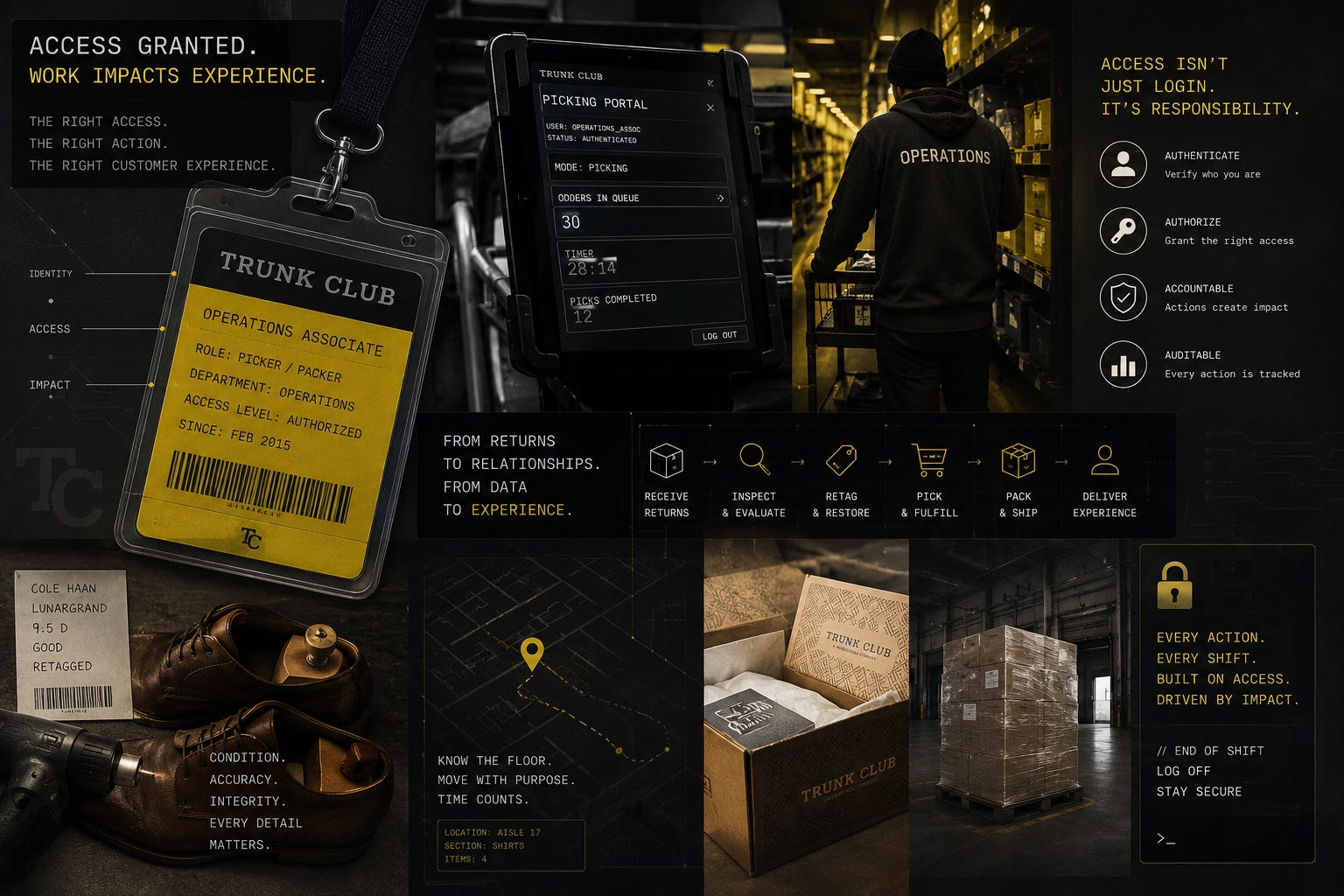
Like the harbor job, I found it on Craigslist. That pattern mattered because I was still learning how to find my own exits. Levi’s had been inconsistent. The harbor had been seasonal. Trunk Club felt like the next door opening.
And I was excited enough about it to tell a few people still at Levi’s that this was the wave and they should come get some money too.
At least three people came through that gateway. Through them, who knows. But it was a gateway for sure.
This was February 2015 to March 2016. My title was Operations Associate, but the role had two lives. I started in inventory. I finished in operations.
Trunk Club still had that startup energy where everything felt impressive, improvised, and a little fly-by-night at the same time. The warehouse was on Goose Island, but the company also had the Ohio Street location downtown, the swanky brick-and-mortar setup where customers could have the try-on experience in person. That side had the rooftop, the polish, the brand environment.
The warehouse had the process.
Inventory was where I started.
We were a team of around eight, and a lot of the work came from items that had already gone through the customer. A customer had received a trunk, tried things on, kept what they wanted, rejected what they didn’t, and sent the rest back. Sometimes it was a clean rejection. Sometimes it was a return after more use. Either way, the decision came back into the building as product.
That’s where we came in.
Items had to be evaluated. Some needed dry cleaning. Some needed steaming. Some needed to be re-tagged. Some were too far gone and had to be damaged out.
Shoes were their own little world.
A lot of them were Cole Haans, Hamiltons, dress shoes, and Chelsea boots before Chelsea boots got run into the ground. If shoes came back looking rough, we’d shoe-horn them and hit them with heat guns to try to recapture the shape. Some customers were clearly trying to juug the process, so the item had to tell the truth even if the customer didn’t.
Then we’d notate the shoe, the model, the condition, and what we’d done with it.
I’d switch tasks sometimes and steam collared shirts or other items that needed it. We also had to look up products in the internal inventory system, and sometimes I think through Trunk Club’s public site, so we could find the SKU, print it, and re-tag the item correctly.
The work wasn’t hard.
It was easy in the way tedious work can be easy, where your brain knows what to do but the shift still moves slow.
That was the first half of Trunk Club for me. Returned product. Condition checks. SKU lookups. Re-tagging. Steaming. Heat guns. Shoes that needed to be saved if they could be saved. Items that had already been considered, tried, denied, or returned.
Looking at it through the buyer’s journey, I wasn’t near the buyer directly anymore.
But I was near the evidence of their decision.
At O’Brien’s, the buyer had already decided.
At Macy’s, I was processing sales and sometimes supporting consideration.
At Levi’s, the buyer was still trying things on.
At DuSable Harbor, the sale was over, but trust still had to be maintained.
At Trunk Club, the customer’s decision came back in a box.
That box carried data, inventory, condition, preference, rejection, and future sales potential. If the item came back and got processed wrong, the next customer experience could be affected. If the SKU was wrong, if the item wasn’t cleaned, if the shoe shape wasn’t restored, if damaged inventory stayed in circulation, the personalized commerce model got weaker.
So even though I wasn’t selling, I was inside the operational layer that made the selling model possible.
After a few months, I wanted to move departments.
Inventory was fine, but it was slow. Operations had more motion, more hours, more music, more people I knew, and more of the late-shift warehouse energy I wanted to be around.
The operations shift came in around 5 p.m. and could go until 10 p.m. or later. There were day operations people too, but the evening shift had a different feel. Music was playing over the warehouse speakers. The homies were there. The managers were cooler. Edwin was cool as hell. Breaks could turn into shenanigans. It had more life to it.
My supervisor Karen pushed back on the move, which I didn’t fully clock then, but later understood as a red flag.
Eventually, I got approved and moved over to operations under Joe.
Joe was cool.
Operations was the iPad-cart side of the business.
You’d take a cart with a basket, and the iPad was mounted on it. You’d log into your profile, pull up the portal, switch it to picking, and start walking the warehouse floor for selections that needed to be fulfilled.
The warehouse had sections. Shoes, coats, shirts, and whatever else. The system didn’t give me some perfectly routed path. You had to know the floor well enough to find what you needed.
If you had to grab 30 items, that was timed.
Your profile tracked the work. Leadership could see it. You could see your own time. The whole thing was measured and gamified enough to make late-shift warehouse people want to be on their shit. There were contests, praise, food, money, and of course free social pressure.
That was the work becoming data.
The other half was packing.
Someone would take the cubbies or containers filled with fulfilled orders to a pack station. That station had a PC and a little label printer. From there, the trunk had to be packed efficiently and correctly. Sometimes that meant actual trunk-like containers. Sometimes it meant branded shipping boxes. Either way, the packing had to match the stylist/customer selections before the order got sealed.
Then the trunks were arranged on the floor, set onto pallets, wrapped, and moved to the bay area to be picked up and loaded onto a truck later.
Some people were designated to build pallets. I think I did it a few times. There was also someone designated to deal with the trash, break everything down, and dispose of it.
Picking was more fun than packing.
Packing was still cool, but picking had more motion. A cart, a login, a timer, a warehouse path, a little pressure, and the music carrying the shift.
That’s where the access lesson showed up.
I had a login, a cart, a timer, and a path through the warehouse. That didn’t mean I had authority. It meant my access had become measurable.
That was different from the earlier jobs.
At O’Brien’s, access was mostly physical and task-based.
At Macy’s, I had POS access but limited authority.
At Levi’s, I had access to fitting rooms, inventory areas, and the customer’s moment of consideration without much control over the close.
At DuSable Harbor, low-ranking access got heavier because it touched gates, payments, customer profiles, and physical infrastructure.
At Trunk Club, access became tracked.
The system knew who was picking. It knew how long it took. It knew what profile the work was under. It knew whether the fulfillment process was moving or dragging.
I wasn’t designing the process. I wasn’t choosing the customer’s wardrobe. I wasn’t building the business strategy. I wasn’t managing the KPI model.
I was just inside it.
And that was enough to see something.
The buyer’s journey doesn’t disappear after the customer clicks, rejects, keeps, or returns something. It turns into work somewhere else.
It becomes inventory.
It becomes a SKU.
It becomes a damaged-out item.
It becomes a heat-gunned shoe.
It becomes a timed pick.
It becomes a packed trunk.
It becomes a metric under somebody’s profile.
That’s what Trunk Club showed me.
The customer wasn’t in front of me anymore, but their choices were still moving through the warehouse.
The decision came back in a box, and my job was to help the system decide what happened to it next.