 Quincy Labs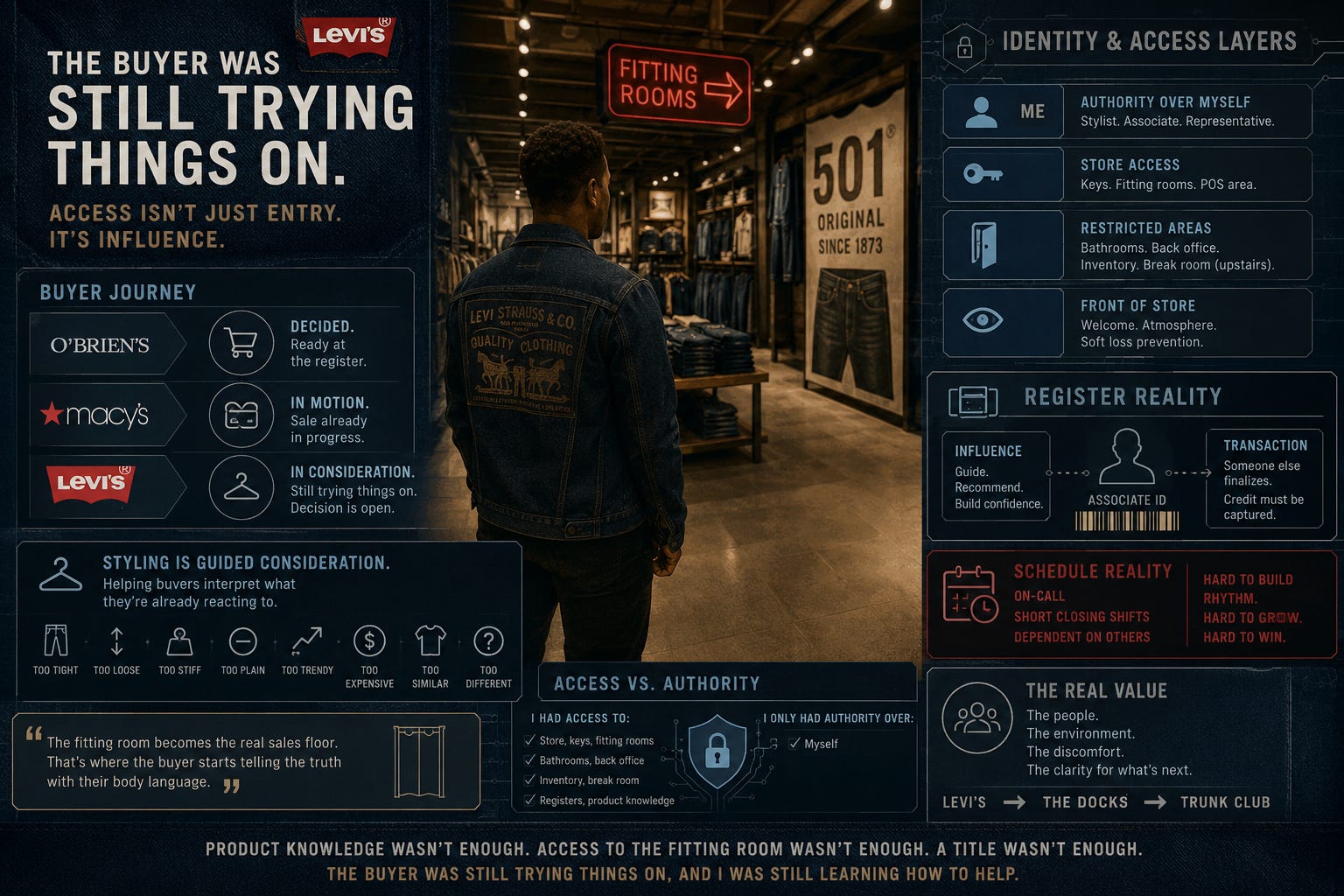
A lot of the time, they were still trying things on.
I worked at the Levi’s flagship on Michigan Avenue from September 2013 to May 2014. My title was Stylist, which sounded cleaner than the role felt while I was inside of it.
On paper, it was about impacting customer shopping habits, helping drive sales through personal connections, maintaining the floor, developing personal sales strategies, and supporting store goals during peak seasons.
In reality, I was still figuring out whether I was even built for that kind of selling yet.
I liked clothes. I liked fashion. I liked denim, jackets, shirts, and the way a fit could change how someone carried themselves. That part made sense to me.
What didn’t come naturally was approaching strangers, building rapport on demand, and turning product knowledge into a conversation that moved somebody closer to buying.
That gap followed me into the role.
I’d come out of Macy’s with enough retail experience to know I wanted something different, or at least something more specific. I remember searching Craigslist and the Levi’s website, trying to find a way in. The job was a pain to get.
The interview was a group interview. Matt Hambric was there, and so was this dude named Adam. I didn’t know how to prepare for interviews then, so I walked in with personality and hope. I remember saying something to Adam that probably showed the wrong kind of curiosity for the room. Matt vouched for me in a way that kept me alive in the process.
Matt was one of those people I’d call a brother in the familiar sense, not blood, but familiar. Fellow Ogden and Lincoln Park connection. Someone who understood me enough in that moment to not let one awkward turn define me.
That mattered.
Once I got the role, though, the title didn’t solve the actual work.
Levi’s had real product knowledge. Fits mattered. A 501 wasn’t the same conversation as a 511, 510, or 514. Wash mattered. Size mattered. Some customers came in knowing exactly what they wanted. Some came in asking for a specific cut or stone wash. Some were tourists who wanted to experience the flagship because of the brand and store history. Some needed more personal help.
That’s where the buyer’s journey was different.
At O’Brien’s, the buyer had already decided.
At Macy’s, I was often processing a sale that was already in motion.
At Levi’s, the buyer was still in consideration.
They might’ve liked the brand but not known the fit. They might’ve known the fit but not the wash. They might’ve walked into the fitting room with five options and come out liking none of them. The sale was still open. The decision could still move.
Styling, when done well, is guided consideration.
It’s not just telling someone what looks good. It’s helping them interpret what they’re already reacting to. Too tight. Too loose. Too stiff. Too plain. Too trendy. Too expensive. Too different from what they normally wear. Too close to what they already own.
The fitting room becomes the real sales floor because that’s where the buyer starts telling the truth with their body language.
I understood pieces of that, but I wasn’t consistent yet.
If my energy was on, or if the customer had a complementary energy that helped cover my shortcomings, I could be useful. I could speak better to a cut I knew. I could help someone think through a pair of jeans or a jacket. I could be present enough to make the interaction easier.
But if I wasn’t on, the role felt harder than the title made it sound.
A lot of the default work was recovery. Opening fitting rooms. Running sizes if someone asked. Cleaning up what came out of the rooms. Refilling fixtures. Making sure items were sized properly. Fixing displays. Greeting people at the front.
Greeting had another layer too. On Michigan Avenue, the front of the store wasn’t just a welcome point. It was also a soft loss prevention position. Tourists, shoppers, people passing through, people who might buy, people who might snatch and grab. You were part of the atmosphere and part of the watch.
So again, access had layers.
I had access to the store once it was open. I had access to the fitting rooms and the keys. I had access to bathrooms, the back office area, the inventory area, the break room upstairs that doubled as storage for mannequins, banners, and whatever else needed somewhere to go.
But I only had authority over myself.
Even the register was different from Macy’s. At Macy’s, registers were spread out across departments, and associates could unlock a POS with their own ID. At Levi’s, the register area was more centralized, one long block of terminals. You had to make sure the customer knew your name so whoever was ringing them up could enter your associate number and credit you properly.
That says a lot about the role.
You could help influence the decision, but someone else might finalize the transaction. You could spend time with the customer, but the credit still had to be captured correctly. You could be close to the sale without fully owning the close.
And even then, the role was hard to build momentum in because I was seldom scheduled.
Sometimes I was on-call. Sometimes I was off. Sometimes I came in for a short three-hour closing shift. It’s hard to develop rhythm in a role when most of your shifts are on-call, short closing shifts, or dependent on someone else calling off.
That was frustrating.
Not in some abstract professional-development way. In a real way. I wasn’t making money sitting at home hoping another person didn’t come in. I didn’t know how to apply myself better inside the situation, so it felt like being trapped inside something I’d signed up for.
That’s a strange feeling.
Wanting the job. Getting the job. Then realizing the job doesn’t actually give you enough room to become good at it or enough hours to make it make sense.
The main value ended up being the people.
Levi’s put me around people I may not have met otherwise. Some of those connections lasted longer than the job. And that matters too, because sometimes a role doesn’t give you the career lesson you expected. Sometimes it gives you the people, the environment, and the discomfort that help you understand what you need next.
Eventually, I found the docks. Then from there, I found Trunk Club.
When I finally had other sources, it felt good to leave Levi’s where I found it.
Looking back, Levi’s didn’t make me a great stylist. It showed me what styling was supposed to require.
Product knowledge wasn’t enough.
Access to the fitting room wasn’t enough.
A title wasn’t enough.
The buyer was still trying things on, and I was still trying to understand what kind of support a person needs before they can guide someone else with confidence.