 Quincy Labs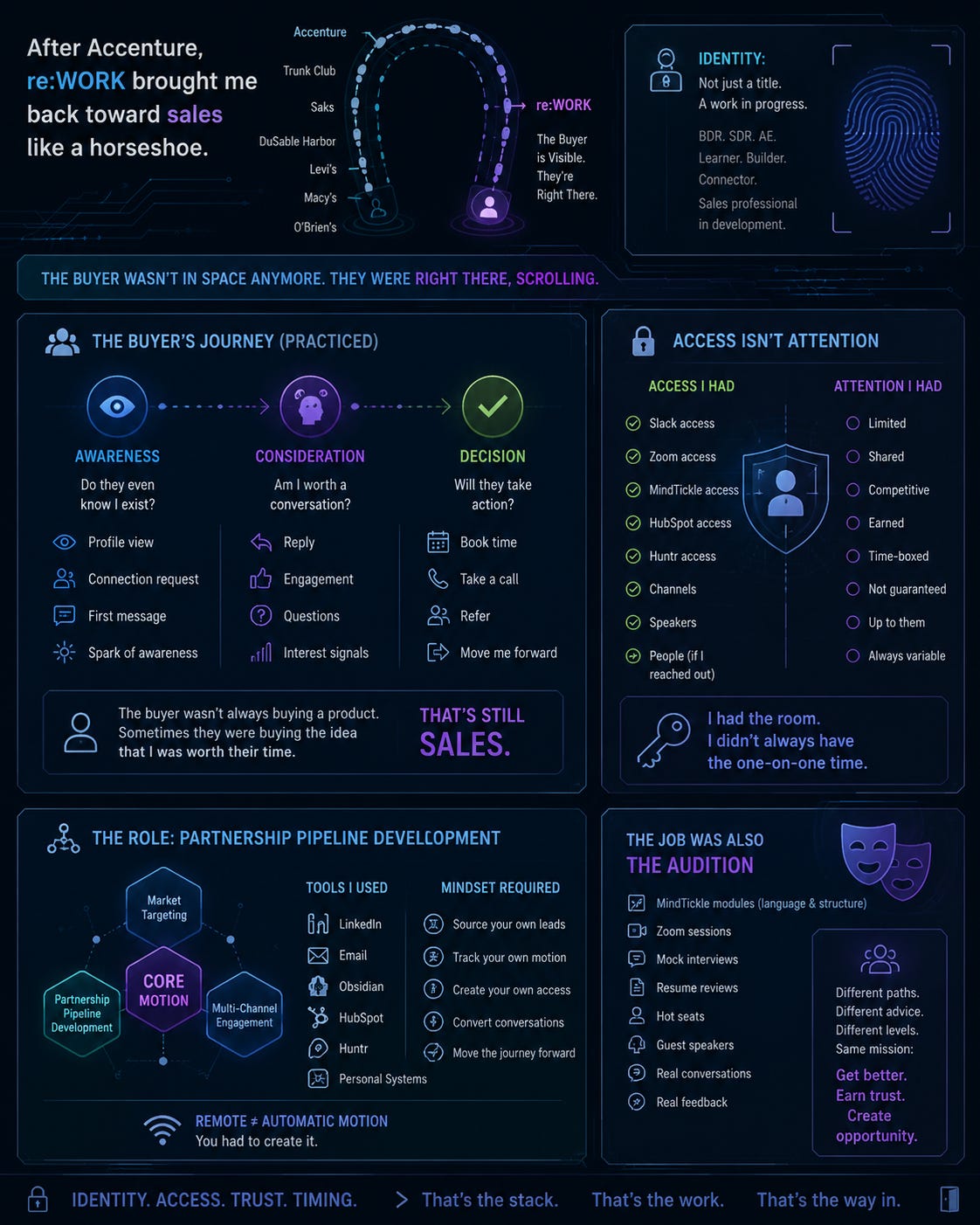
At Accenture, I could see the work but not the deal. The buyer was hidden behind account structure, staffing systems, SOWs I wasn’t seeing, and client relationships that lived somewhere above me.
re:WORK flipped that.
Now the target audience was visible again.
Recruiters. Hiring managers. People already working as BDRs, SDRs, AEs. Employer partners. Donor-adjacent folks. Volunteers. People who could refer, advise, open a conversation, or at least tell me what they were seeing from inside the field.
They were all on LinkedIn.
So the buyer wasn’t in space anymore.
They were right there, scrolling.
That made re:WORK different from everything that came before it. It was a cohort BDR role, and it was experience training, but I’d still frame it as a real role. Mariah functioned as my supervisor. There were expectations. There was a process. There were tools. There was outreach. There was performance, even if it wasn’t a traditional BDR seat with a company territory, comp plan, and manager breathing down your neck.
On paper, the work could be described as partnership pipeline development, market targeting, and multi-channel engagement.
In practice, it felt more like learning to perform sales development while simultaneously using sales development to find my way into sales development.
That’s the funny part.
The job was also the audition for the job.
There were online modules in MindTickle. They covered the language and structure of sales, but I wouldn’t call them dense or overly sophisticated. They helped with phrases, abbreviations, and formal sales language, but I wasn’t coming in completely blank. I’d already been studying sales on my own.
So some of it was new vocabulary for things I’d already been trying to understand.
BDR.
SDR.
AE.
ICP.
Discovery.
Pipeline.
Objection handling.
Follow-up.
Multi-threading.
Signals.
It helped to have the language, but language wasn’t the hard part.
The harder part was motion.
The program had Zoom meetings, mock interviews, resume reviews, hot seats, and moments where you had to be ready to perform. Sometimes BDRs, SDRs, AEs, volunteers, or recruiters would come on and give their version of game. Some of it landed. Some of it didn’t. That’s how these things go. Everybody teaches from whatever their own path made obvious to them.
There was value in that.
But re:WORK was also a nonprofit environment with nonprofit constraints. A lot of people involved were volunteering, already working, building their own thing, or giving what they could when they could. People’s time is valuable, and they don’t let go of it easily when it’s already being drained by ten other things.
That shaped the experience.
Remote made it easy to feel invisible. If you weren’t creating motion, there wasn’t much in the environment forcing motion to happen for you.
You had to source your own leads.
You had to use your own LinkedIn.
You had to track what you were doing.
You had to decide who was worth reaching out to.
You had to figure out how to convert a profile view, a connection, a reply, or a loose conversation into something useful.
For me, that meant regular LinkedIn, email, Obsidian tracking, HubSpot, Huntr, and whatever personal system I could make work. There were edicts dropped here and there, but the motion was mostly self-directed.
That’s where the buyer’s journey came back into frame.
At O’Brien’s, the buyer had already decided.
At Macy’s, I was processing sales and sometimes supporting consideration.
At Levi’s, the buyer was still trying things on.
At DuSable Harbor, the sale was over, but the trust wasn’t.
At Trunk Club, the decision came back in a box.
At Saks, I had keys, access, and buyer-adjacent responsibility without the leverage.
At Accenture, I could see the work, not the deal.
At re:WORK, I was practicing the buyer’s journey by trying to create one.
That was the shift.
Awareness wasn’t theoretical anymore. It was whether someone even knew I existed.
Consideration wasn’t a neat stage in a sales diagram. It was whether a recruiter, hiring manager, employer partner, or person already in role thought I was worth a conversation.
Decision wasn’t a signed contract. It might’ve been accepting my connection request. Replying. Booking time. Taking a call. Referring me. Giving feedback. Letting me ask real questions. Moving me toward an interview.
The “buyer” wasn’t always buying a product.
Sometimes they were buying the idea that I was worth their time.
That’s still sales.
Not enterprise sales. Not full-cycle sales. Not quota-carrying software sales. But sales in the basic sense of creating enough trust, relevance, and timing for another person to take action.
I was close to my intended target audience, but only if I created the closeness myself.
That’s a different kind of access.
I had Slack access. Zoom access. MindTickle access. HubSpot access. Huntr access. Access to channels depending on where I stood in the process. Access to speakers when they came through. Access to people if I reached out and they chose to respond.
But access to a community isn’t the same as access to attention.
I had the room.
I didn’t always have the one-on-one time.
That was probably the most frustrating part. Everybody needed 1:1 time. But the structure often had to split an hour across people with very different levels of technical comfort, communication ability, sales readiness, and even basic familiarity with things like email, video calls, or LinkedIn etiquette.
So sometimes it felt counterproductive.
Not because the information was useless.
Because the variance was too wide.
One person might need help understanding what a BDR even does. Another might need resume language. Another might need interview reps. Another might need basic tech comfort. Another might need actual account strategy. Another might need a straight-up confidence intervention.
Trying to serve all of that in group formats is messy.
Mariah stood out because she was actually committed to the development work, even while building her own thing. That matters because in a structure like that, consistency becomes rare. People can care, but care doesn’t automatically create bandwidth.
I learned that at Accenture too.
At re:WORK, it just looked different.
Instead of an 800K-person corporate machine with internal systems that looked official but didn’t always lead anywhere, re:WORK was smaller, looser, more human, and more dependent on self-direction. The problem wasn’t corporate opacity. The problem was limited infrastructure.
I had the motion.
I didn’t have the machine.
No full sales org behind me.
No assigned territory.
No formal company brand that made every outreach easier.
No paid seat where my only job was to produce pipeline.
No manager with all day to coach me.
No guaranteed access to the people who could sharpen every weak point.
But I did have enough to practice.
I had to write messages.
Track outreach.
Think about who I was targeting.
Understand why someone would respond.
Think about signals.
Build a list.
Follow up.
Take calls.
Ask better questions.
Translate my background into something a hiring manager could understand.
And that’s where the role had real value.
It forced me to stop treating sales as an idea and start treating it as motion.
A lot of people talk about wanting a BDR or SDR role without understanding that the beginning of the job is repetition. It’s not glamorous. It’s identifying people, writing to them, following up, getting ignored, trying again, adjusting your language, learning what sounds fake, learning what sounds too eager, learning what sounds too vague, and learning when somebody’s silence is also data.
re:WORK gave me a place to practice that.
It also showed me that structure determines how far practice can go.
You can give someone a Slack workspace, a module library, a CRM, a speaker series, and a goal. That’s useful. But if the person is remote, unpaid, self-directed, and still building confidence, the difference between motion and momentum often comes down to attention.
Who sees the effort?
Who corrects the message?
Who helps interpret the failed reply?
Who says, “That target is wrong”?
Who says, “That line is too vague”?
Who says, “You’re not asking for the right next step”?
Who helps the person convert activity into skill?
That’s the part people underrate.
Sales development isn’t just activity.
It’s coached activity.
Without coaching, activity can become noise. With the right coaching, the same outreach can become signal.
That’s what I was learning.
re:WORK wasn’t perfect. It was useful and messy at the same time. It gave me access, language, reps, exposure, people, and a reason to keep moving toward sales after Accenture.
It also showed me the limits of a program that relies heavily on self-direction.
But maybe that was the point too.
Because by then, I wasn’t brand new new. I was more like a bird mature enough to be outside the nest. Not fully where I needed to be, but not someone who could wait around for the whole structure to carry me either.
So I had to build the motion myself.
That became the bridge.
From Accenture’s hidden enterprise buyer to re:WORK’s visible target audience.
From internal staffing systems to external outreach.
From waiting for opportunity to trying to create conversations.
From seeing the work but not the deal to learning how to start the deal path, even if the deal was just getting someone to take me seriously.
That’s what re:WORK gave me.
It taught me that outreach can get you close to the buyer, but structure determines whether that closeness becomes momentum.