 Quincy Labs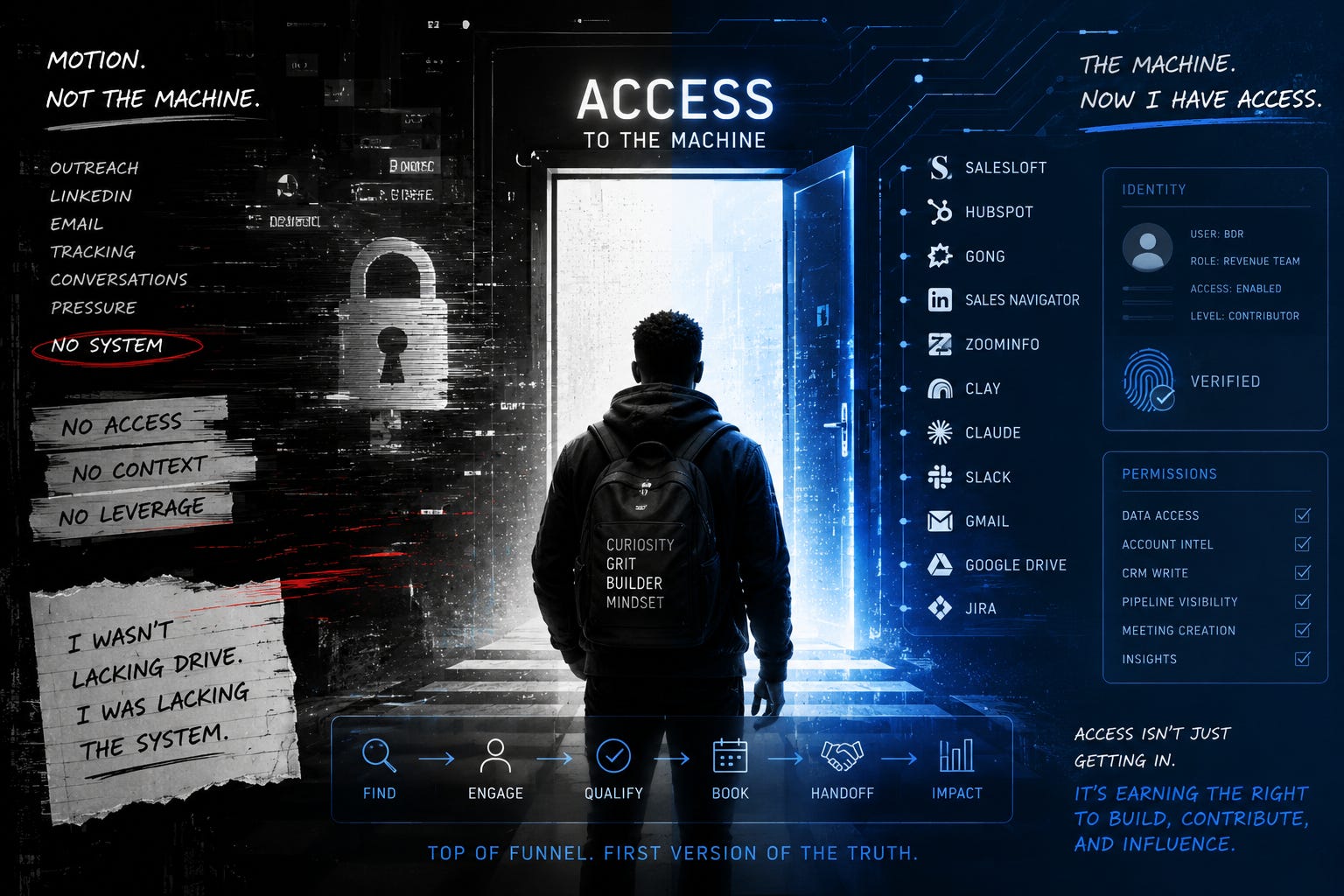
At re:WORK, I had the motion, not the machine. I had outreach, LinkedIn, email, tracking, conversations, and the pressure to create opportunity for myself. But I didn’t have a full commercial system behind me.
1stbase was different.
Now there were territories. AEs. Inbound demo requests. Outbound sequences. Cold calls. SalesLoft. HubSpot. Gong. Sales Navigator. ZoomInfo. Clay. Claude. Slack. Gmail. Google Drive. Jira. Account research. Meeting targets. Weekly calls. Midweek calls. Recaps. Pipeline talk. Handoffs. CRM hygiene. AI experiments.
The machine existed.
The machine was also messy.
This role came through SV Academy after I completed the program. On paper, I was a Business Development Representative. The agreement involved SV Academy, 1stbase, and AppDirect in different ways, and I was paid hourly through SV Academy via Gusto. It wasn’t a stipend in the way the word can sound at face value. It was minimum wage.
The setup already had some strange energy.
I didn’t have the cleanest official job description from 1stbase itself. The opportunity came toward me with the feeling of, “you should probably take this,” which I now understand as a red flag. That doesn’t mean the opportunity had no value. It means the framing wasn’t as clean as it should’ve been for someone stepping into a revenue role.
Before I officially started, I was flown out to their sales kickoff in New Orleans in January.
That made it feel more real.
Then I started in February 2026. 1st week, they got me my device, an M1 MacBook. Compared to some of the environments I’d been in before, that signaled a more resourced setup. This wasn’t me trying to build motion out of a cohort Slack and my own LinkedIn anymore. This was a company with tools, systems, buyers, and a product to sell.
But the page kept turning fast.
Onboarding tasks came up in the 1st week and then didn’t really stay centered. The expectation shifted quickly from “get situated” to “start moving.”
And to be fair, I did start moving.
The product itself made sense.
1stbase sold IT device lifecycle management: procurement, provisioning, warehousing, global shipping, asset retrieval, device wiping, IT asset disposition, MDM integrations, and the operational pieces that matter when companies have distributed employees.
The target buyer was usually someone in IT, operations, security, or a related leadership seat. These were people dealing with employee onboarding, laptop logistics, identity provisioning, offboarding, compliance, and the general mess of making work devices appear, function, and come back when they’re supposed to.
That meant the buyer’s journey was no longer abstract.
At O’Brien’s, the buyer had already decided.
At Macy’s, I was processing sales and sometimes supporting consideration.
At Levi’s, the buyer was still trying things on.
At DuSable Harbor, the sale was over, but the trust wasn’t.
At Trunk Club, the decision came back in a box.
At Saks, I had keys, access, and buyer-adjacent responsibility without leverage.
At Accenture, I could see the work, not the deal.
At re:WORK, I had the motion, not the machine.
At 1stbase, I was finally close to the SaaS buyer.
The buyer was on the other end of the call, the email, the LinkedIn touch, the inbound demo request, or the account list.
My job was to create awareness, qualify interest, and move the right people toward a meeting with an AE.
That’s real top-of-funnel work.
It’s also where the risk sits.
The top of funnel looks lightweight until you realize it controls the 1st version of the truth.
A BDR isn’t just “booking meetings.” The role shapes who gets contacted, what pain is named, how urgent the problem sounds, what information makes it into the CRM, how the AE understands the account, and whether the opportunity looks real enough to move forward.
That’s not small.
That’s account intelligence, narrative framing, qualification, and system-of-record influence sitting inside one early-career seat.
I was working across territories from jump, including LATAM and EMEA as normal territories, not as some late experiment. I handled inbound demo requests from the start. I worked outbound sequences across different verticals and motions. I used SalesLoft for activity, HubSpot for CRM, Gong for call review, Sales Navigator for prospecting, ZoomInfo and Clay for enrichment, and Claude for research and messaging support.
I had access to everything in Gong.
I had access to internal tickets in Jira too, even though there was a lag getting me access and I was told it wasn’t a big deal.
That kind of thing matters.
Because 1stbase taught me that access to revenue systems is not the same as control over the revenue system.
I had access to the tools that shaped pipeline truth, but not the authority to fix the system producing that truth.
That was the core tension.
The official work was simple enough to describe: find accounts, find people, reach out, qualify interest, book meetings, log activity, hand off context, and help create pipeline.
The lived work was harder because the data and workflows didn’t always line up cleanly.
One person who left a few weeks after I started said the quiet part out loud: I shouldn’t have to reconcile fragmented data just to book a meeting.
That stuck with me because it named something I was feeling.
The hard part wasn’t only “sales is hard.”
Of course sales is hard.
The harder part was that everyone had a workflow, but the workflow wasn’t always a system.
Everybody showed me their workflow, but not everybody knew how to explain the logic behind it.
One person used the tools one way. Another person used them another way. Someone would show me how they personally moved through an account, but not always why that sequence of steps mattered. Eventually, I got better once I understood where the data lived and how I preferred to use the tools myself.
But that took reconciliation.
SalesLoft had one surface.
HubSpot had another.
Gong had another.
Sales Navigator had another.
ZoomInfo had another.
Clay had another.
Claude could help, but only if the inputs were good and the judgment around the output was sharp.
That’s where AI got interesting too.
The team became increasingly interested in using AI to build things, speed things up, research better, message better, and get ahead. The energy was basically, there has to be some way we can use this to leverage ourselves forward.
That instinct wasn’t wrong.
But there weren’t clear AI rules around what data could be pasted into Claude, what had to stay out, what needed review, what counted as sourced, or where the audit trail lived.
So the role had AI acceleration without a clear governance layer.
That’s a real access issue.
If you give a rep account data, call transcripts, CRM context, prospect information, and AI tools, you’re giving them a lot of practical power. They can research faster, write faster, personalize faster, summarize faster, and create internal narratives faster.
But faster isn’t automatically better.
Faster can also mean hallucinated personalization, shallow relevance, copied assumptions, and pipeline stories that sound clean before they’re actually true.
That was one of the strangest parts of the role.
The company wanted speed and autonomy, but the system still needed clarity and calibration.
The meeting target added to that tension.
The ideal language was basically three meetings a week, though the way it was talked about made it feel like: that’s the standard, do what you can, pipeline generation matters too, and most people on the team seldom hit this consistently anyway.
So I was left trying to understand the real target.
Was three the expectation?
Was one acceptable?
Was activity the real measure?
Was pipeline quality the real measure?
Was I doing well if I was generating signal, but not booking enough?
Was I behind if I was being praised?
The confusing part was being told I was doing the right things while the main metric still wasn’t moving enough. That left me in a weird place: good enough to praise, not good enough to convert.
That messes with confidence.
I didn’t feel confident because the targets never felt fully real. I had activity, tools, praise, feedback, and effort. I was hitting the ground running in the way people kept saying I was. But I didn’t have the clarity that turns effort into traction.
And still, I know I generated $3.1MM in pipeline.
That matters.
I’m not going to pretend the role produced nothing just because it didn’t convert into a full-time seat. Pipeline was created. Work was done. Accounts were researched. Inbound calls were qualified. Outbound motion happened. Handoffs were made. Notes were logged. Context was gathered.
But the residency still ended without conversion.
I got an extension, technically two weeks, but in lived time it was more like twelve or thirteen days because of how it landed. That gave the appearance of more runway, but not enough runway to change the structure underneath the experience.
That’s the part I keep coming back to.
1stbase showed me that getting close to the buyer doesn’t mean the sales motion is clean.
I was closer to the buyer than I’d been at Accenture. I had more infrastructure than I had at re:WORK. I had a real product, a real territory, real buyers, real tools, and real activity.
But the system around that closeness was fragmented.
The AppDirect and 1stbase context added to that too.
From the correspondence I had, I thought I was interviewing for AppDirect. It wasn’t until the final interview that 1stbase became its own context in my mind. By then, I’d already been moving through the process, trying to make sense of who the role was actually for, what the company structure meant, and where the accountability sat.
That might sound minor.
It isn’t.
Brand context matters when you’re interviewing. Parent company, subsidiary, product, sales motion, buyer, and internal expectations all shape how you prepare. If those boundaries blur, the candidate has to spend extra effort just understanding the room they’re walking into.
That same boundary issue showed up later in the work.
Whose rules govern the sales motion?
Whose AI standards apply?
Whose CRM expectations matter most?
Whose definition of a qualified meeting wins?
Who owns the mess when conversion doesn’t follow activity?
Those are not philosophical questions when you’re the person being measured.
They become your day.
Even the small authority issues told the same story.
I didn’t have authority over basic things, like whether my camera could be off on a call where I had nothing to contribute. That might sound small, but small controls are still controls. Sometimes a workplace shows you its operating logic through the petty stuff.
It wasn’t just the systems either.
There was also the social layer.
I felt the isolation of being melanated in a space where there were a few more of us on the broader AppDirect side, but not really on the 1stbase BDR or sales side in the same way. That changes how certain comments land. Not because every awkward comment is a grand event, but because when you’re one of the only people in the room who has to hear it differently, you’re also the one forced to decide whether it’s worth naming.
At one point, someone joked about “whipping” the team into shape for a cadence.
That’s just not good business language.
It doesn’t require a dissertation. It doesn’t require a victim speech. It’s basic social competence. In a professional setting, around people you don’t fully know, with different histories and identities in the room, there are words you should be smart enough not to use casually.
That moment didn’t define the whole role.
But it fit the broader feeling.
Too much responsibility was placed on the person receiving the mess to decide whether to correct it, absorb it, laugh it off, or keep moving.
That was part of the emotional load.
The role itself already required a lot of context switching. Calls. Emails. LinkedIn. CRM. Research. AI. Handoffs. Activity. Weekly review. Midweek review. Territory work. Inbound. Outbound. Notes. Signals. Pipeline.
Then add the social monitoring.
The camera stuff.
The unclear conversion path.
The unclear meeting target.
The fragmented tools.
The pressure to create pipeline.
The praise that didn’t become stability.
That’s a lot to hold for a minimum-wage residency.
But I don’t want to flatten 1stbase into just a complaint.
There was value there.
I learned more about real SaaS sales motion in those months than I could’ve learned from another round of theory. I got to see how inbound qualification works. I got to see how outbound breaks down when targeting, messaging, data, and timing don’t align. I got to see how much a BDR shapes the internal story of an account before the AE ever gets involved.
I got to see why CRM hygiene matters.
I got to see how Gong can become a learning tool.
I got to see how AI can help and confuse at the same time.
I got to see how account intelligence can become useful or theatrical depending on how grounded it is.
I got to see how a sales org can have tools without having a shared operating system.
That might be the most important lesson.
Tools are not a system.
A CRM is not a system.
A sequence is not a system.
A Gong library is not a system.
An AI prompt is not a system.
A weekly call is not a system.
A system is when those pieces connect cleanly enough that a person can understand what matters, why it matters, how success is judged, and what to do differently when the outcome isn’t there.
That’s what I needed more of.
Because at the top of funnel, the work is already unstable. Most people don’t respond. Most accounts aren’t ready. Most messages don’t land. Most calls don’t connect. Most signals are partial. Most personalization is a guess until the buyer confirms it.
That’s the nature of outbound.
So the internal system has to be cleaner than the external reality.
At 1stbase, I felt the opposite too often.
The external reality was hard, and the internal system was messy.
That’s why this role belongs as the ninth piece in the series.
It brought the buyer back into reach.
It gave me the machine.
It showed me how the machine can still fail to turn effort into trust when the structure underneath it isn’t clean enough.
Looking back across the whole journey, 1stbase is the 1st role where all the themes really collapsed into one place.
Buyer access.
Identity access.
Data access.
AI access.
CRM access.
Narrative access.
Pipeline pressure.
Managerial ambiguity.
Social context.
And the old question underneath all of it:
What does access actually give you if you don’t have the authority to change the system you’re inside?
1stbase taught me that being close to the buyer only matters if the system around that closeness can turn signal into trust.