 Quincy Labs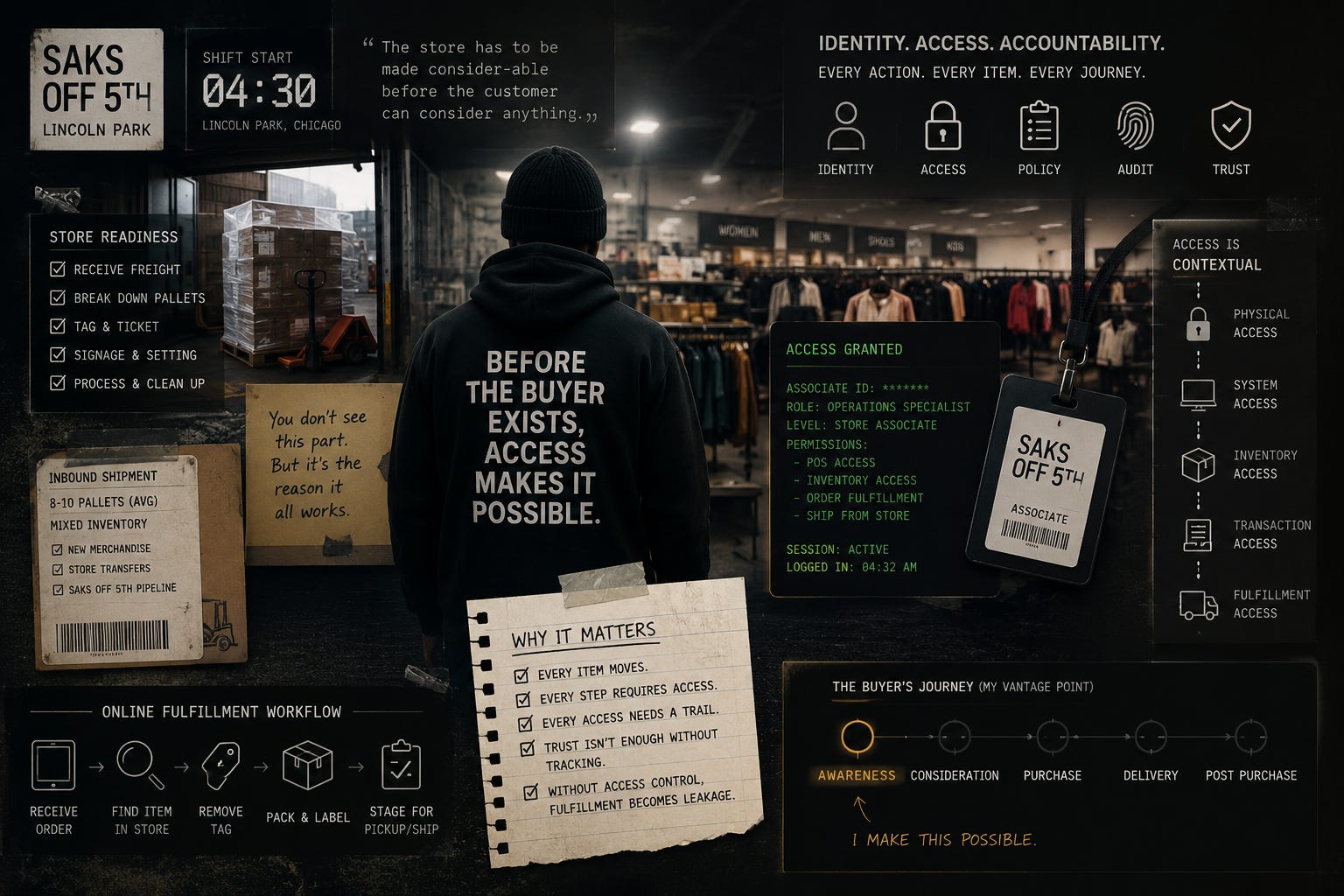
Not literally, but functionally.
I was working at Saks OFF 5TH in Lincoln Park, and I was initially hired as an Operations Specialist. This was around March 2016. My shift started at 4:30 in the morning, which meant leaving from the South Side, biking or catching a bus to the Red Line, then riding north while most people were still asleep.
That alone made the job feel different.
Retail usually shows itself to the customer once the lights are on, the doors are open, the signage is placed, and the racks look halfway intentional. But somebody has to be there before that. Somebody has to receive the freight, break down the pallets, tag the product, fix the signage, process what didn’t get processed, and make the floor ready for the person who’s going to walk in later thinking they’re just browsing.
That was the part of the buyer’s journey I was closest to in Chicago.
Store readiness.
Before the customer could consider anything, the store had to be made consider-able.
At first, that meant being there with Diego, the key holder at the time. Some mornings, the whole first question was whether Diego was actually there. If he wasn’t, I was outside in whatever weather Chicago decided to be that day, waiting around with no real control over the situation. Sometimes Monica, the store leader, might be involved too. But the basic issue was simple: I could be responsible enough to show up at 4:30 a.m., but still not have the access needed to get inside.
That’s a specific kind of powerless.
Once the store got opened and activated, we’d head to the inventory room and start handling whatever had been left for us. Sometimes it was work from the early shift. Sometimes it was something left from later in the day. Then the doorbell would ring, which usually meant the shipment truck was downstairs.
We’d take the freight elevator down and start unloading with the pallet jack.
A standard shipment could be eight to ten pallets. On a slower inbound day, maybe three or four. Since this was Saks OFF 5TH, the product could be new merchandise, transfers from another store, or whatever came through that discounted Saks pipeline.
Ideally, the pallets were stacked and wrapped cleanly.
That didn’t always happen.
If the pallet was awkward, leaning, or shaped like somebody wrapped it with a grudge, getting it up the elevator was its own little game. Once it made it upstairs, we’d break it down by department. Men’s, women’s, kids, shoes, whatever it was. Then we’d stage it on fixtures so the morning associates could process it once they came in.
After shipment, there was always more.
Tagging. Ticketing. Adding stickers. Placing signage. Rearranging areas for promotions. Cleaning up whatever the sales day had left behind. Fixing things that hadn’t been processed correctly the first time.
Shoes were some of the worst.
Men’s, women’s, children’s. Mix-matched pairs. Stickers removed. Bottoms dirty because somebody tried them on and walked around like the store was their closet. And then you’d still have to deal with the SKU or UPC situation, trying to match the physical item back to whatever the system thought it was.
Department store inventory is its own kind of mythology.
I’m not saying that as a joke either. The taxonomy of a department store is always pretending to be more accurate than the floor allows it to be. Products move. Customers move them. Associates recover them. Tags get pulled. Stickers get switched. Boxes get separated from shoes. Systems say one thing, the floor says another, and the person doing inventory has to negotiate between both.
That was one side of the role.
The other side was access.
At the Lincoln Park store, there were maybe eight or nine registers. You accessed them with your associate ID. Once my operational duties were done, I could check customers out if needed, especially if another task had brought me toward the register area.
But the more interesting access issue was online fulfillment.
That workflow made the store feel like a warehouse hiding inside a sales floor.
You’d take an iPad and fulfill online orders from Saks or Saks OFF 5TH customers. The customer had already bought the item online. The store inventory had to satisfy the order. So now you were walking the floor like a fake personal shopper, finding items that were already paid for, removing security tags, boxing them, printing shipping labels with customer address information, and setting them aside for pickup.
I noticed the loss-prevention issue at the time.
If someone is pulling paid merchandise from the floor, removing the security tag, printing a label, and staging it somewhere, the audit trail needs to be clean. If there isn’t clear history around what label was printed, what order it belonged to, who handled it, and where the item went, that’s not just a process gap.
That’s an access gap.
Because from the outside, it might look like fulfillment.
From the inside, it’s also a path where merchandise can move out of the store with less friction than normal.
That didn’t mean everyone was doing something wrong. It meant the process depended on trust, tracking, and discipline. If any of those were loose, the risk was already there.
That’s where Saks started to connect back to the theme of this series.
At O’Brien’s, the buyer had already decided.
At Macy’s, I was processing sales and sometimes supporting consideration.
At Levi’s, the buyer was still trying things on.
At DuSable Harbor, the sale was over, but the trust wasn’t.
At Trunk Club, the decision came back in a box.
At Saks in Chicago, the buyer wasn’t there yet, but the store still had to be made ready for them. The buyer’s journey was upstream from me, but everything I touched could affect whether that journey felt clean once they arrived.
Then came the key.
Diego eventually had to leave after a workplace incident involving comments he made. I’m not going to turn that into the center of this, but it changed the access reality inside the store.
Before or around that period, I’d been given a key.
So now I was a key holder.
Kind of.
I officially changed the title, but everything else mostly stayed the same. There wasn’t some major pay jump or grand repositioning. If there was an increase, it was probably a quarter or fifty cents, something funny like that. The real business need was simpler: somebody needed to be able to open the store when the truck got there.
Then I became a key holder in the most retail way possible.
The business needed someone reliable enough to open the door, but not enough to fully reposition me around the responsibility.
That’s the whole tension.
A key gives the appearance of authority, but it doesn’t automatically give leverage. It doesn’t let you make your own schedule. It doesn’t protect you from being left outside when somebody else is late. It doesn’t mean the business sees the responsibility the same way you feel it in your body at 4:30 in the morning.
It just means now you can get in.
Eventually, my life started moving in a different direction.
I was in a relationship with Brianna at the time, and we decided to move to Los Angeles. I’m grateful for that chapter, but it was also a mistake in the way certain life decisions can be both. You don’t always know what a move is going to cost until you’re already inside it.
I thought transferring to LA would mean transferring my role.
I figured I’d stay in operations, keep rocking, and just continue from another store.
That’s not what happened.
The transfer got approved, but the Beverly Connection store only had openings in Jewelry. Not operations. So I get to LA, go to the store to situate everything, and find out I need to re-interview with them.
That was my first clue that this wasn’t going to be a simple continuation.
The Beverly Connection store was across from the Beverly Center Macy’s, which is funny in hindsight because I moved out there with Brianna and ended up working near the kind of Los Angeles retail geography people only understand if they were really outside in it.
California also changed the structure around work.
Breaks, lunches, pay rules, the way time was treated, the whole thing felt different from Chicago. I’m not saying that from some legal analysis. I’m saying that as somebody who went from one retail environment into another and immediately felt the operating system had changed.
And then there was Jewelry.
That was a complete pivot.
In Chicago, I had freight elevators, pallets, inventory rooms, online fulfillment, bank deposits, register support, signage, promos, and operational routines. In LA, the buyer was right there.
No early-morning buffer.
No shipment work to hide inside.
No back-of-house rhythm I already understood.
Just the customer, the counter, the item, and the expectation that I’d sell.
Jewelry put me back into direct consideration and decision support. A customer looking at jewelry is usually weighing more than the object. They’re thinking about price, taste, occasion, gift value, status, how it looks, whether it feels cheap, whether it feels special, whether the person they’re buying it for might like it.
That’s a different kind of pressure than unloading a truck.
I can say I gained some social experience there. I gained some sales experience too, even if it was more tacit than formal. I was directly next to the customer in a way I hadn’t been in Chicago operations.
But I was also overwhelmed.
My personal life was loud at the time, and it bled into how I experienced the role. LA was a culture shock. The pace was different. The attitude was different. The utility of everything felt different. Even basic work expectations felt like they belonged to another script.
The management culture also felt clique-heavy in a way I didn’t know how to navigate. There were clear favorites, clear in-groups, and a social code I wasn’t fluent in.
That’s not unique to that store. Sales environments can get like that anywhere. But in LA, inside that specific department, while I was already dealing with a personal-life transition, it hit different.
They stayed on me about pants too, which was hilarious in its own way because this was still a discount store trying to act like the floor was Rodeo Drive.
At one point, somebody even gave me a card to go buy pants for a jewelry event because we were going to be in front of the “good people” and I needed to look the part.
I love that for me.
But that was also part of the role. Presentation mattered more in Jewelry. The look mattered. The department mattered. The buyer’s perception mattered. I’d come from operational usefulness, where the question was whether the truck got unloaded and the store got ready. Now the question was whether I looked and sounded like someone who belonged near the case.
That was a different kind of access.
In Chicago, I had access to the store before the buyer arrived.
In LA, I had access to the buyer without the operational authority I’d built my confidence around.
That’s the contrast.
Chicago gave me keys, registers, deposits, freight, fulfillment, and the feeling that I was trusted with the bones of the store, even if the leverage didn’t match.
LA put me closer to the buyer, but farther from the part of the business where I felt competent.
That’s why Saks belongs in this series.
It shows that being closer to the buyer isn’t always a promotion in practice. Sometimes it’s just a different exposure. A different risk. A different way to feel underprepared.
I didn’t make it a full year in that LA version before I pivoted to Vox DJs for the interim, then eventually decided to leave LA and come back to Chicago.
Looking back, Saks taught me a lot about access.
A key can open the door without changing your standing.
A register login can let you process a sale without giving you control over the sales environment.
An iPad can let you fulfill an online order without making the process secure.
A transfer can move you closer to the buyer while stripping away the part of the job that made you useful.
That’s what I understand now.
Saks taught me that access can put you inside the building before it gives you any real leverage inside the system.