 Quincy Labs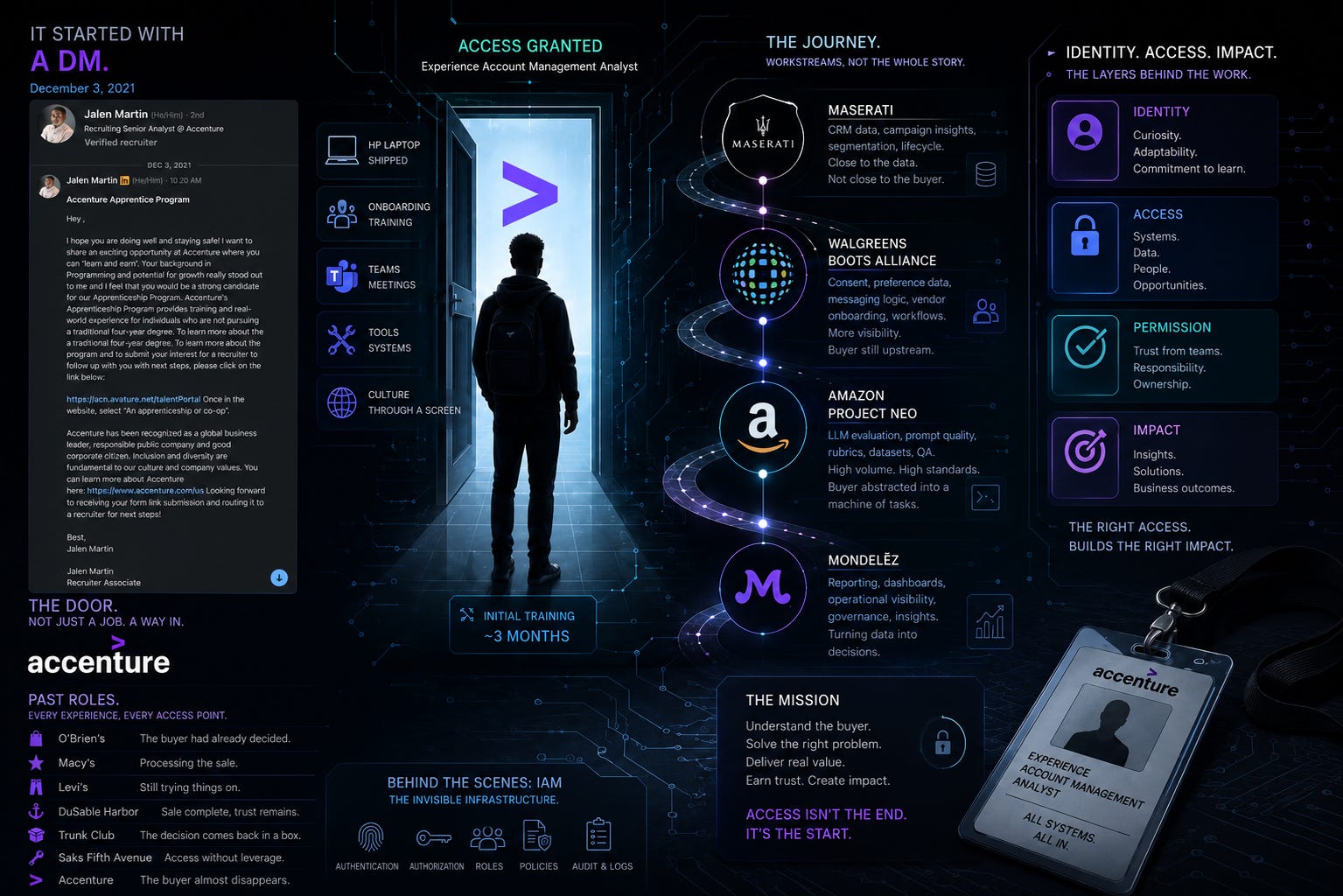
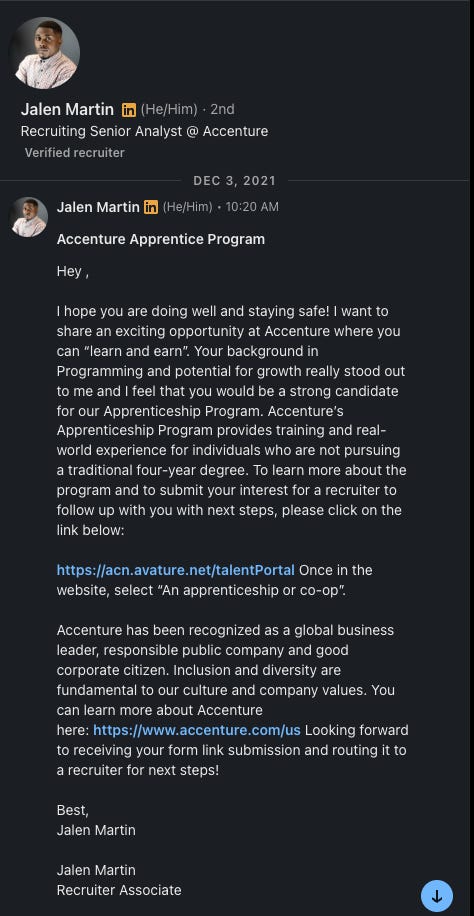
On December 3, 2021, Jalen Martin reached out about the Accenture Apprentice Program.
“Hey,
I hope you are doing well and staying safe! I want to share an exciting opportunity at Accenture where you can ‘learn and earn’. Your background in Programming and potential for growth really stood out to me and I feel that you would be a strong candidate for our Apprenticeship Program. Accenture’s Apprenticeship Program provides training and real-world experience for individuals who are not pursuing a traditional four-year degree.”
That was the door.
At the time, it felt like a real way into something bigger. Not another retail floor. Not another warehouse. Not another role where I had to find my way through Craigslist and hope the situation had enough hours to make sense.
This was corporate.
Remote.
Digital.
Accenture.
My final interview was with Masha Safina, and I remember sharing some research I’d done around quantum in general. I didn’t have the perfect corporate polish yet, but I had curiosity, and at that point curiosity had gotten me through more doors than formal preparation had.
Eventually, I got the offer. Then I had to wait for things to actually begin.
When it did start, Accenture shipped me an HP laptop, and I entered the giant ecosystem from home. The initial training period was around three months if I’m remembering right. It was very 9-to-5 on Teams. Meetings, onboarding, trainings, tools, culture, internal systems, all of it through a screen.
My official initial title was Experience Account Management Analyst.
We were in Accenture Song, right around the era where Accenture Interactive had become Song. The company was also heavy on the metaverse at the time, which is funny now because every large organization eventually rotates into whatever word is carrying the market. Back then it was metaverse. Now it’s AI. Crypto was probably too steep of a moat for them to make the full corporate mascot.
That onboarding period made the apprenticeship sound structured.
Consulting turned out to be much less linear than that.
After training, around April 2022, I was placed on Maserati. That was my first real CRM project.
The role had me near customer data, but not near the customer. I was working with summarized CRM campaign data, performance patterns, customer segmentation, vehicle and lease logic, and the kind of lifecycle marketing information that helps an account team understand what might be happening across a customer base.
But I wasn’t close to the buyer.
That distinction became one of the main lessons of my Accenture experience.
At O’Brien’s, the buyer had already decided.
At Macy’s, I was processing sales and sometimes supporting consideration.
At Levi’s, the buyer was still trying things on.
At DuSable Harbor, the sale was over, but the trust wasn’t.
At Trunk Club, the decision came back in a box.
At Saks, I had keys, access, and buyer-adjacent responsibility without the leverage that should’ve come with it.
At Accenture, the buyer almost disappeared.
Not because there wasn’t a buyer. There obviously was. Enterprise work doesn’t just appear out of nowhere. Someone had to decide there was a problem worth paying for. Someone had to select Accenture. Someone had to approve the scope, the budget, the timeline, the workstream, the team structure, and whatever version of value was being promised.
I just wasn’t shown that layer.
I could see the work.
I couldn’t see the deal.
Maserati also introduced me to the reality that not every Accenture team felt built by Accenture. Some teams had been acquired into the ecosystem and wore Accenture like a hat. They had their own habits, their own workflows, their own rhythm, and then Accenture sat on top of that as the name around it.
That was my first introduction to consulting as something stitched together.
Then came Walgreens Boots Alliance.
That work was more consent and customer preference oriented. Messaging logic. Preference data. Vendor onboarding checks. Workflow design. Documentation. Meetings where external parties were actually present, so I could at least see a little more of the client-facing structure.
Still, the buyer was somewhere upstream.
By the time I touched the work, the problem had already been turned into a workstream. The business need had already been defined enough for people to gather around it. My job was not to ask why Walgreens needed customer preference management. My job was to help document, organize, translate, and support the workflow that already existed.
That’s a very specific position in the buyer’s journey.
You’re not in awareness.
You’re not in consideration.
You’re not in decision.
You’re in delivery after the decision has already become an engagement.
After Walgreens, Amazon Project Neo became the longest chapter.
That was LLM evaluation and prompt-quality work. We started with SharePoint or something adjacent to it, and it was trash enough that the workflow had to mature. Eventually we were using an Accenture upload tool. The work itself was high-volume, structured, repetitive, and quality-sensitive.
I authored prompts and completions across different NLP task categories. I worked inside rubrics, examples, annotation guidance, quality thresholds, and model-output review patterns. The team had to care about consistency because inconsistency at scale becomes a governance problem.
That’s where the work got interesting, even if the buyer was still nowhere near me.
The client need had already been abstracted into a machine of tasks. Prompt dataset development. QA criteria. Output review. Uploads. Reviews. Corrections. Rubrics. Guidance. Repeat.
The buyer’s journey had become a production system.
Then Mondelez came later, around late 2024 into early 2025. That work was reporting, dashboards, operational visibility, and global market performance. Files, dashboards, trackers, reporting systems, all the above. The goal was to help leadership see what was going on without everything depending on manual updates and scattered sources.
Again, I could see the work.
The data.
The reporting problem.
The dashboards.
The workflow friction.
The leadership visibility need.
But the commercial path that brought me there was still behind the account structure.
That’s why Accenture belongs in this buyer’s journey series.
It taught me the enterprise version of distance.
In retail, distance from the buyer is physical. The customer is either in front of you or they’re not.
In consulting, distance from the buyer can be structural. The buyer can be inside the same general engagement and still be completely out of view.
You can be working on a client problem without understanding how the client bought the solution.
You can support a deliverable without knowing what the SOW promised.
You can sit in meetings without knowing the RACI.
You can be staffed on a project without knowing who had real decision authority.
I didn’t see an SOW until around two years in.
That’s wild to me now.
Because without the SOW, you’re missing the commercial truth of the work. You can understand your task and still not understand the deal. You can understand the deliverable and still not understand the promise.
That mirrored the internal staffing experience too.
The official system told me to search the internal boards. The lived system taught me that many roles were already taken, ghost-posted, or staffed through relationships before the board meant anything.
And I’ll be direct: that internal role board experience was trash.
Workday made it look like opportunity was sitting there in a searchable system. But a lot of what I saw felt stale, already spoken for, badly maintained, or disconnected from how teams actually staffed themselves. Leadership could point to the system and say, “look there,” but the real movement seemed to happen through networks, timing, relationships, and whoever already knew who needed what.
That’s another access lesson.
The internal systems made it look like access existed.
The staffing culture taught me access and visibility weren’t the same thing.
At an 800K-person company, it’s easy to feel invisible. Especially when you’re new to the culture, remote, trying to understand the language, trying to find a role, trying to upskill, trying to market yourself internally, and trying not to get swallowed by a bench process you don’t fully understand.
I had people assigned to me.
Peer mentors.
A people lead.
People who cared in moments.
But care and capability aren’t the same thing.
I had people who could meet with me on Teams, ask how things were going, share what they knew, and try to help within the limits of their own jobs, lives, upbringing, and context. What I didn’t have was a mentor with the right context, authority, and availability to help me navigate the machine.
That’s not me saying nobody cared.
It’s me saying care wasn’t enough.
In a company that large, you need more than encouragement. You need someone who can help you understand how power, staffing, visibility, timing, and opportunity actually move.
I didn’t have that in the way I needed it.
And I didn’t yet have the confidence I have now to build that around myself.
For a long time, I worked fully remote and took advantage of that work-from-home rhythm. I didn’t go into the office regularly for at least a year and some change.
Eventually, I started going in for volunteer things, ERG happy hours, and later DJing some of those spaces. Cartez W Parker helped with that, and through those moments I started to understand the office differently.
I could badge into Accenture Tower at Ogilvie, get past the turnstiles, take the elevator up, move across floors, book rooms, grab snacks, sit in private booths, wander through common areas, and still not know where the real opportunity was moving.
That’s the difference between physical access and institutional access.
I had a badge, a laptop, and a company email.
What I didn’t have was access to the rooms where the work became opportunity.
DJing the ERG events helped me learn that visibility wasn’t automatic. You had to create some of it yourself. Not in a desperate way. In a practical way. People have to know you exist before they can think of you. And in a massive organization, existing quietly is almost the same as not existing at all.
That was hard to learn while also trying to do good work.
It was also hard to learn while still trusting systems and people that didn’t always deserve that level of trust.
I felt overwhelmed because the company was huge.
I felt constrained because I didn’t fully understand how I was being perceived.
I felt invisible because the work didn’t always translate into opportunity.
I felt curious because I could see enough of the machine to know there was more to understand.
And eventually, I felt the weight of being part of a standard consulting process.
You get hired.
You get trained.
You get staffed if you can.
You sit on the bench if you can’t.
You search systems that may or may not reflect reality.
You network with people who may or may not have useful context.
You take trainings to make yourself more marketable.
You learn that “business development” can be treated like an auxiliary thing even though it’s clearly central to how work gets created.
You try to survive performance conversations shaped by utilization, chargeability, project fit, timing, and who knows what else.
And if it doesn’t work out, the company keeps moving.
I was laid off in February 2025.
Accenture didn’t stop making companies because I left.
That’s not bitterness. That’s scale.
A company that big can absorb your entire chapter as a minor administrative event. But for you, it can be years of life, identity, effort, confusion, adjustment, and learning how to read rooms you were never fully invited into.
That’s what Accenture gave me.
Not just project experience.
Not just CRM, consent governance, LLM evaluation, or reporting.
It gave me a clearer understanding of how enterprise work can separate the person doing the work from the person buying the work.
It showed me that the buyer’s journey can disappear behind account structures, staffing systems, internal politics, and delivery layers.
It showed me that access can be formal but not useful.
A badge.
A laptop.
A title.
A Teams channel.
A Workday posting.
A project assignment.
All of that can be real access and still not be the access that changes your position.
Looking back, Accenture taught me that access to the work isn’t the same as access to the deal.