 Quincy Labs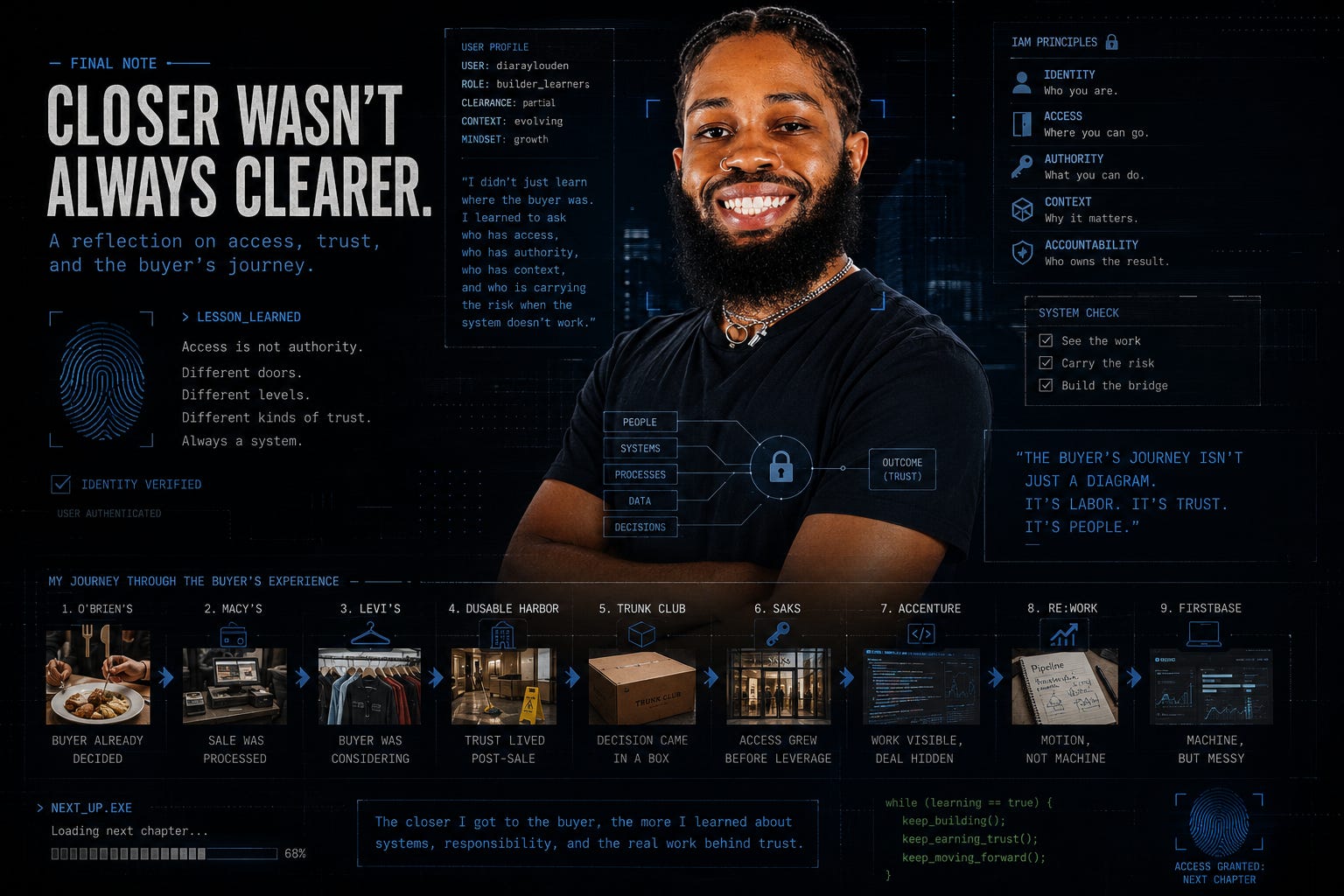
At first, I was just looking back.
Old jobs. Old uniforms. Old commutes. Old versions of myself trying to figure out what kind of work made sense, what kind of people I could tolerate, what kind of environment made me feel useful, and what kind of access I had without fully understanding what that access meant.
But once I started putting the roles next to each other, the pattern became hard to ignore.
Every job placed me somewhere different in relation to the buyer.
At O’Brien’s, the buyer had already decided.
At Macy’s, I was processing the sale.
At Levi’s, the buyer was still trying things on.
At DuSable Harbor, the sale was over, but the trust wasn’t.
At Trunk Club, the decision came back in a box.
At Saks, I had the keys, not the leverage.
At Accenture, I could see the work, not the deal.
At re:WORK, I had the motion, not the machine.
At Firstbase, I had the machine, but the machine was messy.
That became the arc.
Not a perfect climb. Not a clean ladder. Not some over-polished story about how every job was secretly preparing me for one obvious destination.
It was more irregular than that.
Sometimes I was close to the customer but not close to the decision. Sometimes I was close to the product but not close to the buyer. Sometimes I had access to systems without access to context. Sometimes I had responsibility without authority. Sometimes I was trusted enough to hold the process together, but not enough to shape the process itself.
That’s what this series really became about.
Access.
Not just identity access management in the technical sense, though that thread is there too.
Physical access. Store access. Register access. Gate access. Warehouse access. Badge access. CRM access. Buyer access. Data access. Narrative access.
Every role had an access story.
At first, access was simple. Could I get into the building? Could I touch the product? Could I stand near the customer? Could I run the plate, ring the register, open the fitting room, clean the dock, or pull the item?
Later, access got more abstract. Could I see the CRM? Could I read the data? Could I understand the SOW? Could I tell why the account mattered? Could I influence the handoff? Could I shape the first version of pipeline truth?
The more the roles evolved, the more the access evolved.
But the lesson stayed the same.
Access is not authority.
That’s the main thing I know now that I didn’t know then.
A teenager running food can be close to the final moment of service without having any control over the promise that brought the buyer there.
A retail associate can process a sale without really making the sale.
A stylist can be near the fitting room, near the decision, near the customer’s body language, and still not have the confidence, mentorship, or rhythm to guide the moment well.
A dock worker can have gate codes, customer profiles, payment information, and physical access to high-trust spaces without having much say over the operation.
A warehouse worker can touch the customer’s returned decision through inventory, SKUs, packing stations, and timed workflows without ever seeing the customer.
A key holder can open the store before sunrise and still not have leverage inside the system.
A consultant can work on client data, dashboards, documentation, consent workflows, CRM reporting, and LLM evaluation while still being nowhere near the buyer who made the commercial decision.
A BDR in training can practice the motion without the full machine.
A BDR in a SaaS motion can finally get close to the buyer, the tools, the CRM, and the pipeline, then realize the system around that closeness still has to be clean enough to turn signal into trust.
That’s the part I keep returning to.
The buyer’s journey is not just a marketing diagram.
It’s work.
It’s labor.
It’s restocking shelves.
It’s cleaning bathrooms.
It’s matching shoes back to the right box.
It’s opening a store before the customer arrives.
It’s pulling online orders from a sales floor that’s pretending not to be a warehouse.
It’s writing CRM notes.
It’s qualifying an inbound demo.
It’s deciding what context an AE inherits before the first real sales call.
It’s also risk.
Because every handoff can distort the truth a little.
Every system can hide the work a little.
Every role can grant access before granting enough context to use that access well.
That’s why I’m grateful for the path, even with the mess.
I didn’t learn sales from one role.
I learned pieces of it across all of them.
Before I had the language, I was already watching people decide.
Before I knew what consideration meant, I was watching customers compare.
Before I knew what post-sale trust meant, I was cleaning the environment that had to justify the purchase.
Before I knew what fulfillment meant in a business sense, I was watching decisions turn into inventory, labels, and packages.
Before I knew what pipeline meant, I was learning how easily the story of an opportunity can become more powerful than the raw truth underneath it.
That’s useful now.
Because I don’t just see “sales” as persuasion.
I see it as a system of trust.
A buyer has to trust the message.
Then the product.
Then the handoff.
Then the implementation.
Then the data.
Then the support.
Then the people behind the system when something breaks.
And inside that system, the people closest to the work often see the risk first.
They see when the floor is messy.
They see when the SKU is wrong.
They see when the label process is loose.
They see when the CRM story is cleaner than the real account.
They see when the internal system is harder to navigate than the buyer’s problem.
That doesn’t automatically give them authority.
But it does give them perspective.
That’s the perspective I’m carrying forward.
I can speak about the buyer’s journey because I’ve been near different parts of it.
Not only the clean parts. Not only the strategic parts. The operational parts too. The awkward parts. The post-decision parts. The parts where a customer’s experience depends on someone who may not have a fancy title, but still holds a piece of the trust.
I can speak about access because I’ve had enough of it to know what it does and doesn’t solve.
A badge doesn’t mean leverage.
A login doesn’t mean context.
A key doesn’t mean authority.
A CRM seat doesn’t mean control over the revenue system.
A title doesn’t mean the system is prepared to develop the person holding it.
And proximity to the buyer doesn’t mean clarity if the surrounding structure is foggy.
That’s why closer wasn’t always clearer.
Sometimes getting closer to the buyer made the work more visible.
Sometimes it made the system more confusing.
Sometimes it showed me where trust was built.
Sometimes it showed me where trust was being assumed.
If I could tell younger me anything, I wouldn’t just say “be more confident.”
That sounds nice, but it skips the real lesson.
I’d tell him to pay attention to what the access is teaching him.
Pay attention to what you’re allowed to touch.
Pay attention to what you’re responsible for.
Pay attention to what you’re blamed for.
Pay attention to what you can see but can’t change.
Pay attention to who has context, who has authority, and who just has the login.
That’s where the real education was.
This series is a soft close for now, but it’s also a signal.
I’m not in tech sales, GTM, buyer journey work, or IAM-adjacent conversations from theory alone. I’ve entered with a lived map of how decisions, access, trust, operations, and systems show up at different levels of work.
I’ve been close to the plate, the register, the fitting room, the dock, the warehouse, the freight elevator, the dashboard, the outreach sequence, and the CRM.
None of those places gave me the whole picture by themselves.
Together, they gave me a way to read the picture differently.
So the final lesson isn’t that I’ve always been in sales…
It’s that I was learning sales before I had the language for it.
And now that I have the language, I’m also clear on the question underneath it:
Who has access, who has authority, who has context, and who is carrying the risk when the system doesn’t work?
Ta-ta for now…